 blog
Should You Spray Paint Your Kitchen Cabinets?
Last Updated: October 25, 2026
Quick Summary
Spray paint kitchen cabinets delivers a smoother, more even finish than brushing, and most homeowners report satisfaction with the result. However, spray painting requires serious preparation, substantial ventilation, higher skill, and extensive masking to prevent overspray, making it best suited for large, open kitchens rather than small or tight spaces.
- Spray application produces a smooth, even finish with no visible brush strokes, while brushing leaves visible texture under bright lighting.
- Spraying requires 4-6 hours of setup time for masking and protection, but application takes only 1-2 days versus 3-5 days for brushing.
- Overspray is the biggest concern, landing paint on walls, floors, countertops, and appliances, requiring hours of masking with plastic sheeting and tape.
- Proper cure time is several days to a week or more; reassembling doors or resuming use before full cure causes early scuffs and peeling.
- Brushing requires less preparation and equipment, making it more practical for small kitchens, tight budgets, and detailed trim work.
Table of Contents
- The Case for Spray Painting Kitchen Cabinets
- Real Drawbacks: Why Spray Painting Isn't Right for Every Kitchen
- Spraying vs. Brushing Kitchen Cabinets: Which Delivers Better Results
- How to Paint Kitchen Cabinets with a Sprayer: Key Steps and Setup
- Professional Cabinet Painting Cost: What You Actually Pay
- Kitchen Cabinet Paint Durability: How Long Your Finish Will Last
- Get Your Cabinet Project Scoped and Estimated
- Frequently Asked Questions
The Case for Spray Painting Kitchen Cabinets
When you spray paint kitchen cabinets, you get a smoother, more even finish than brushing and rolling, and most homeowners who choose to spray paint kitchen cabinets report satisfaction with the result.
But spray painting also brings challenges brushing doesn't, so weigh both sides against your kitchen, timeline, and comfort level.
The question isn't whether spray painting can work, but whether it makes sense for your situation. Here are the genuine pros, real drawbacks, and how it compares to other methods.
Real Drawbacks: Why Spray Painting Isn't Right for Every Kitchen
Spray painting kitchen cabinets requires serious preparation and carries real risks that many homeowners underestimate.
Overspray is the biggest concern. Paint lands on walls, floors, countertops, and appliances, and masking takes hours.
Ventilation demands are substantial. Fumes concentrate quickly, and many kitchens lack adequate airflow. Fans and open windows help but don't fully solve it; poor ventilation means stronger fumes and longer drying times.
Skill matters more than most guides admit. Spray painting isn't easier than brushing: correct angle, consistent distance, and pressure control take practice, and uneven coverage, drips, and spray patterns are hard to fix once dry.
Equipment setup takes time and attention. The right sprayer adds rental or purchase cost, and thorough cleaning after each session is mandatory, skip it and the nozzle clogs.
Spraying vs. Brushing Kitchen Cabinets: Which Delivers Better Results
The choice between spraying and brushing comes down to finish quality, time investment, and your skill level.
Spray application produces a smoother, more even finish. Atomized paint settles uniformly, brush strokes disappear, and the result looks clean and contemporary.
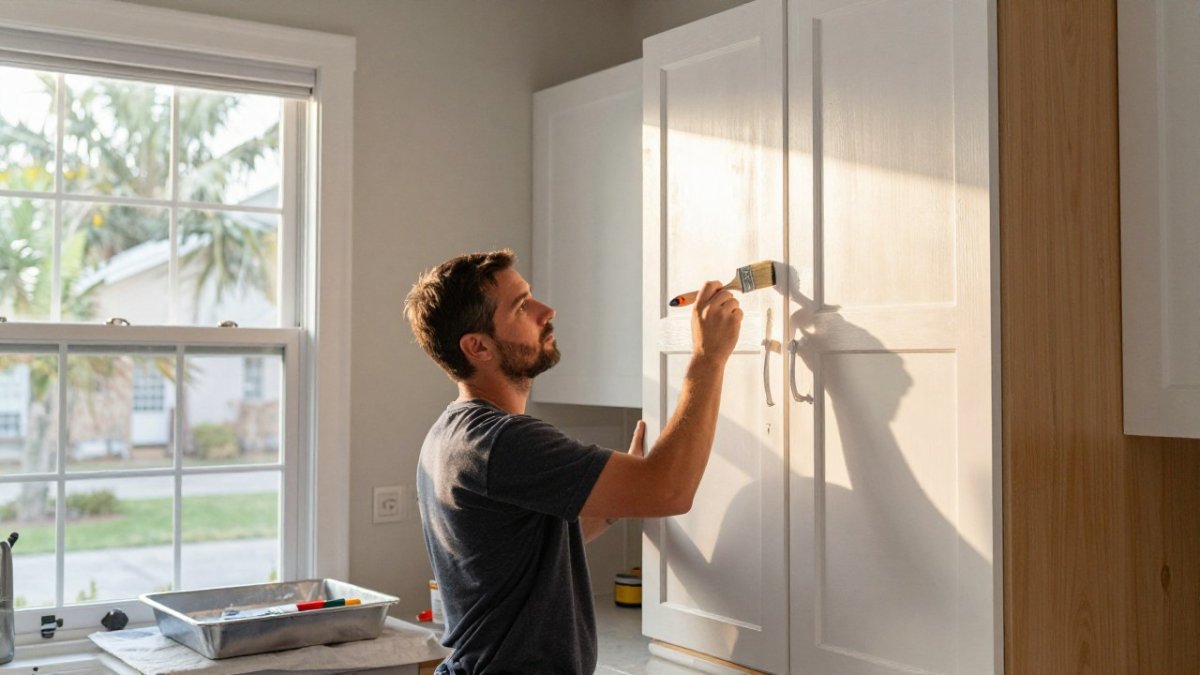
Brushing requires less preparation and equipment. Brushes, paint, and a drop cloth, no sprayer to rent, no complex masking, simpler cleanup.
Spraying saves labor time but demands more setup time. Application takes minutes instead of hours, but masking and protecting the space can take a full day, narrowing the total-time advantage.
Brushing allows better control in tight spaces. Corners, edges, and detailed trim are easier to paint precisely with a brush, while spraying in confined areas risks overspray on unwanted surfaces.
| Method | Finish Quality | Setup Time | Application Speed | Skill Required | Best For |
|---|---|---|---|---|---|
| Spray | Smooth, even | 4-6 hours | Fast (1-2 days) | High | Large, open kitchens with good ventilation |
| Brush | Textured, visible strokes | 1-2 hours | Slow (3-5 days) | Medium | Small spaces, tight budgets, detail work |
| Rolling | Moderate texture | 2-3 hours | Moderate (2-3 days) | Low | Large flat surfaces, less detail |
How to Paint Kitchen Cabinets with a Sprayer: Key Steps and Setup
To spray paint kitchen cabinets properly, you need a methodical approach. Skipping steps leads to poor results and wasted material.
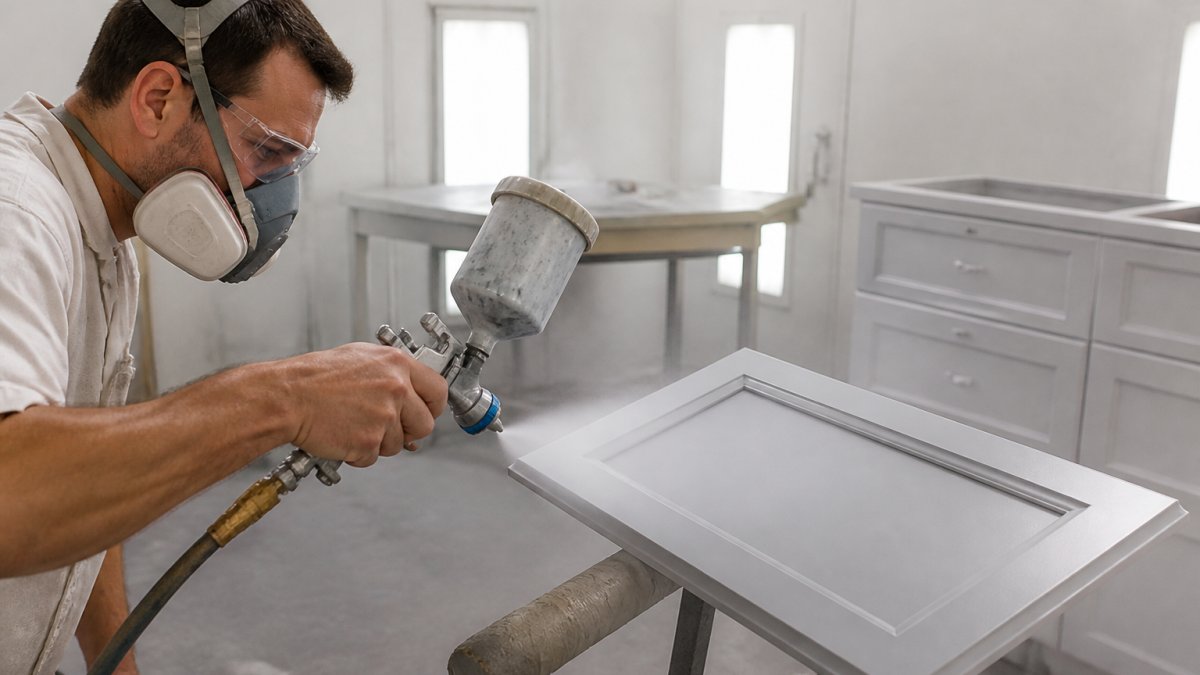
Start with thorough surface preparation. Remove doors and hardware, degrease every surface, sand lightly, and fill gaps with wood filler.
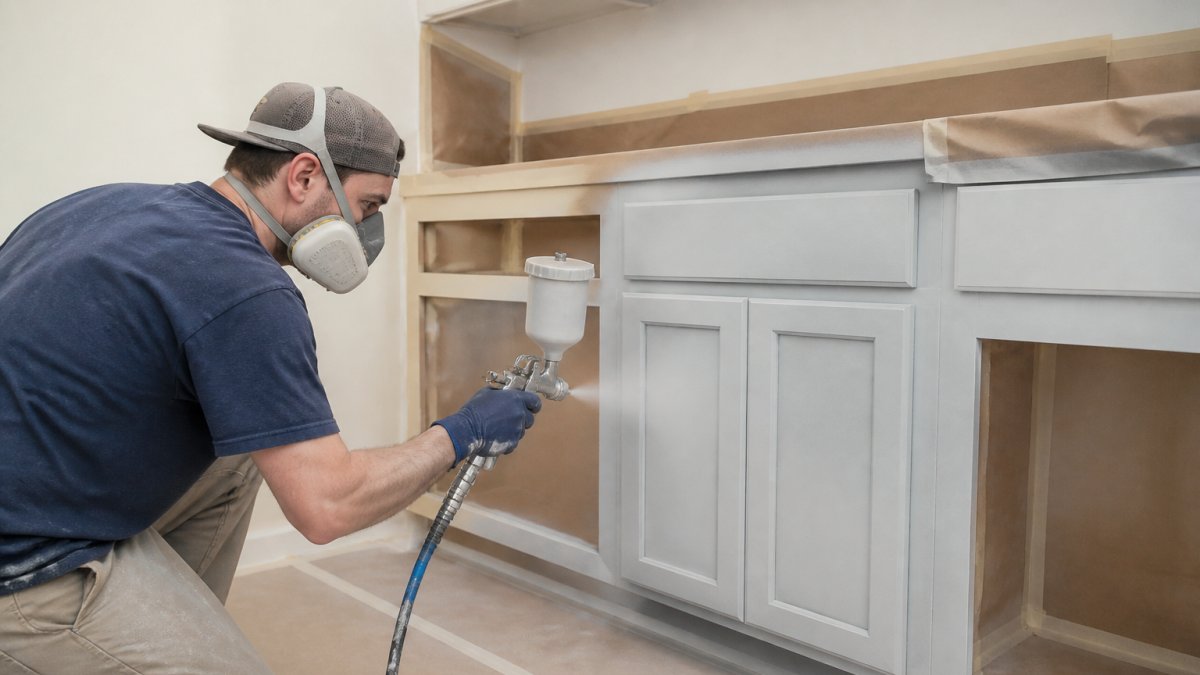
Set up your workspace carefully. Ventilate with open windows and fans, lay plastic sheeting and drop cloths, and tape off baseboards, trim, and adjacent surfaces.
Choose the right sprayer and settings. Handheld electric sprayers suit most cabinet projects, and HVLP (high-volume, low-pressure) models reduce overspray.
Apply primer first. Primer improves adhesion and coverage, especially over stained wood or big color changes.
Spray paint in thin, overlapping passes. Hold the sprayer 6-8 inches away at a consistent angle, move smoothly, and overlap each pass by about 50 percent. Multiple thin coats beat fewer thick ones.
Allow adequate drying time between coats. Spray-applied paint dries quickly but needs time to cure fully.
Reassemble carefully once paint cures fully. Reinstall hardware and doors only after full cure, and install handles and hinges gently to avoid scratches.
Professional Cabinet Painting Cost: What You Actually Pay
Most articles say professional painting "saves money versus replacement" and stop, leaving you without a usable number. Here is a transparent, like-for-like way to compare spraying, brushing, professional work, and replacement.
First, separate the four options you are actually comparing.
- DIY brushing or rolling: lowest cash outlay, highest labor time, visible texture.
- DIY spraying: moderate equipment cost, fast application, steep learning curve and heavy masking.
- Professional spraying or spraying-plus-hand-finishing: highest cash outlay per project, best finish consistency, warranty and prep included.
- Cabinet replacement: highest total cost, new boxes and doors, longest disruption.
What drives the price of a professional job. Pricing is built from four inputs: the number of doors and drawer fronts, linear footage of frames and trim, the condition of the existing finish (grease, peeling, previous coatings, damage), and the coating system specified. A slab door in good condition costs far less than a glazed raised-panel door, heavy grease adds prep labor, and off-site door finishing adds removal, transport, and reinstallation.
Typical U.S. price ranges to anchor your budget. Professional cabinet painting commonly runs from the low thousands for a small, simple kitchen to well over ten thousand for a large kitchen with extensive prep and premium coatings. Use these as planning bands and expect a written quote inside them after an on-site assessment. DIY spraying costs a fraction once you add up sprayer, primer, cabinet-grade paint, masking supplies, and respirator, but consumes far more time and carries higher rework risk.
A transparent sample estimate (illustrative). For a mid-size kitchen with about 20 doors and 10 drawer fronts, frames included, in average condition with light grease and no major repairs, a professional spray project breaks down into preparation and masking, minor repairs and sanding, primer coat, two finish coats, and reinstallation and cleanup. Expect those itemized rather than bundled. Ask for the coating product by name, the number of coats, the cure window before reinstallation, and what the warranty covers, those four answers tell you more about value than the bottom-line price.
Compare like with like. The fair comparison is total cost of ownership over the expected service life, not "professional spray price" versus "a can of paint." A DIY job that fails in two years can cost more than a professional job that lasts many years, while replacement resets the clock at the highest cost and disruption. Put all four options on the same timeline.
Questions that protect your budget. Ask whether the quote includes door removal and reinstallation, hardware removal and reinstallation, overspray protection, what happens if a door is damaged, and whether touch-up paint is provided. A quote that omits these isn't comparable to one that includes them.
For a clear understanding of your specific project, get a professional cabinet painting estimate that itemizes preparation, coating system, number of coats, cure window, and warranty.
Kitchen Cabinet Paint Durability: How Long Your Finish Will Last
Understand what "durable" means for a kitchen cabinet. Cabinets aren't walls: they face repeated opening and closing, hand contact around pulls, steam and grease near the range, and frequent wiping.
Cure time is not the same as dry time. Spray-applied paint may feel dry in hours, but most cabinet coatings need several days to a week or more to reach full hardness.
Cleaning habits matter more than most homeowners expect. Abrasive pads, scouring powders, and ammonia- or bleach-heavy cleaners break down a cured film.
Touch-ups are normal, not a sign of failure. Keep a small amount of the exact paint, labeled with product, sheen, and date.
Repairability depends on the coating system. A catalyzed two-component coating or high-quality waterborne acrylic-alkyd resists blocking and cleaning better than basic latex wall paint.
Realistic service-life expectations. Learn how to prevent cabinet paint peeling to protect your finish from common failure points after spraying. With proper preparation, a quality cabinet coating, full cure before use, and gentle cleaning, a sprayed cabinet finish holds up well for many years in normal residential use, with first wear at edges and around hardware.
Get Your Cabinet Project Scoped and Estimated
Cabinet painting transforms your kitchen when done correctly, and the choice between spray painting, brushing, and professional application depends on your layout, timeline, and comfort level.
Spray painting delivers the smoothest, most even finish but requires more preparation, ventilation, and skill. It suits large, open kitchens with good airflow and simple cabinet designs; smaller spaces, tight budgets, or complex layouts may favor brushing or professional work.
Before committing to any approach, understand the full scope of your project. Learn how to properly prepare kitchen cabinets for painting so you know what's involved. If you're considering professional cabinet painting, review cabinet refinishing scope and cost estimation to understand what drives pricing. And if you want color inspiration before starting, explore the best kitchen cabinet paint colors to find options that match your style.
The difference between projects that look great for years and those that fail comes down to preparation and execution.
Ready to move forward? Get a professional cabinet painting estimate with detailed scope and transparent pricing. You'll know exactly what's included, how long the work takes, and what to expect before any paint touches your cabinets.
Frequently Asked Questions
Can you use spray paint to paint kitchen cabinets?
Yes, but spray paint differs from a paint sprayer. Standard spray paint cans lack the volume and control needed for cabinet doors and frames. A proper paint sprayer (HVLP or airless) is the right tool for kitchen cabinets. Spray paint cans work only for small trim or touch-ups. A sprayer applies paint more evenly and covers large surfaces faster, making it the professional choice for cabinet refinishing.
Is spraying better than brushing for painting kitchen cabinets?
Spraying produces a smoother, more even finish with fewer visible brush strokes than brushing or rolling. However, spraying requires more setup, masking, and ventilation. Brushing is slower but gives you more control and requires less equipment. For a contemporary, polished appearance, spraying wins. For budget-conscious DIY work in tight spaces, brushing may be practical.
How long does spray-painted cabinet paint take to cure?
Drying time (touch-dry) is typically 1-4 hours depending on paint type and humidity. Full curing, where the finish hardens completely and resists wear, takes 7-14 days. During this curing period, avoid heavy use, slamming doors, or placing items on shelves. Temperature and humidity affect cure time; cool, damp conditions slow it. LMJ Bright Painting Services accounts for this in their timeline and provides clear guidance on when cabinets are safe to use fully.
Do spray-painted kitchen cabinets last as long as professionally painted cabinets?
Durability depends on surface preparation, paint quality, and application technique, not spraying alone. LMJ Bright Painting Services prioritizes careful preparation, controlled application, and proper curing conditions, which extends durability. High-traffic kitchens see faster wear.
Cabinet painting is one of the highest-impact renovations you can make in your kitchen. The finish quality, durability, and appearance depend on method, preparation, and execution. LMJ Bright Painting Services brings veteran-owned expertise to every cabinet project, with clear planning, transparent cost estimation, and careful surface preparation that protects your investment. Get started with a free estimate and see how professional cabinet painting can transform your space.