 How-to
How to Schedule Commercial Painting Without Disrupting Business
Last Updated: November 7, 2026
Quick Summary
To schedule commercial painting without disrupting business, start with a documented site assessment and a written scope, then build a dated timeline with decision points that runs from that walkthrough to final sign-off. Paint one zone at a time and reopen each area before the next phase begins, and use after-hours or weekend work to keep the space open.
- Build the timeline backward from the date you need the space back, then add buffer.
- A mid-size office or retail repaint can take several weeks from first walkthrough to sign-off.
- Assign one internal point of contact to handle access windows and crew questions.
- Build one to two days of slack into work that depends on exterior conditions.
- Confirm reopening criteria with the contractor in writing before occupants return.
Table of Contents
- Start With a Site Assessment and a Written Scope
- Building Your Commercial Painting Project Timeline
- How to Prepare a Business for Painting
- Planning Commercial Painting After Hours and on Weekends
- Your Commercial Painting Scheduling Checklist
- Contingencies, Phased Work, and Occupant Safety
- Request a Written Scope and Free Estimate Before You Book
- Frequently Asked Questions
Start With a Site Assessment and a Written Scope
Learning how to schedule commercial painting starts long before anyone picks up a brush. It begins with a site assessment and a written scope, because those two documents decide every date that follows.
A site assessment is a documented inspection of the space before work is priced or planned. It records surfaces, conditions, access points, and protection needs. Without it, any start date you agree to is a guess.
What the Walkthrough Should Cover
Walk the space with the person who will actually manage the job. Cover these points:
- Surface types and current condition, including patching and prep needs
- Ceiling heights, tight corners, and any areas needing lifts or ladders
- Doors, elevators, loading routes, and after-hours access rules
- Furniture, equipment, and fixtures that must be moved or covered
Write the scope from that walkthrough. A written scope lists what gets painted, what prep is included, what is excluded, and how each work zone will be protected. Get it in writing before you compare dates.
If you are planning a larger office, retail, or managed property project, review commercial interior painting planning for phased work zones before you set a start date.
Building Your Commercial Painting Project Timeline
A commercial painting project timeline is a dated plan that maps each phase from site visit to final walkthrough, with decision points that trigger the next step.
A mid-size office or retail repaint can take several weeks from first walkthrough to sign-off, with the actual painting occupying only part of that time. The rest is assessment, approval, material lead time, prep, and inspection.
A Dated Timeline With Decision Points
Use this sequence as a working template. Each step has a trigger that must be met before the next date is locked.
- Site assessment and written scope (Day 0). Walk the space with the person who will manage the job. Decision point: scope signed off by your internal point of contact before an estimate is requested.
- Estimate and approval (Days 1-5). Review the detailed estimate against the written scope. Decision point: written approval and purchase order, if required, before any dates are held.
- Material ordering and crew booking (Days 5-10). Confirm paint, supplies, and crew dates. Decision point: material lead times confirmed in writing; specialty coatings or custom colors can add days.
- Pre-mobilization walkthrough (2-3 days before start). Confirm access, protection plan, and staging areas. Decision point: keys, alarm codes, and parking confirmed.
- Prep and protection (Days 10-12). Move furniture, mask edges, lay drop cloths. Decision point: work zones cleared and signed off by your point of contact.
- Painting by zone (Days 12-20). Work through one area at a time to keep the rest open. Decision point: each zone inspected and reopened before the next begins.
- Touch-ups and inspection (Days 20-22). Fix flaws and check edges under good light. Decision point: punch list created and assigned.
- Final walkthrough and sign-off (Day 22). Review the finished work together. Decision point: sign-off and final payment release.
A Sample Week-by-Week Schedule
The table below shows how a phased office repaint might run. Adjust the durations to your square footage and crew size.
| Week | Phase | What Happens | Business Impact |
|---|---|---|---|
| 1 | Assessment and scope | Walkthrough, written scope, estimate | None |
| 2 | Approval and booking | Scope signed, materials ordered, dates locked | None |
| 3 | Prep and Zone A | Protection set, Zone A painted | Zone A closed |
| 4 | Zones B and C | Remaining zones painted in sequence | Limited access |
| 5 | Touch-ups and walkthrough | Inspection, fixes, sign-off | Normal access |
Book your contractor in advance, since busy periods can fill calendars quickly. For help keeping the job on track, see these commercial painting project management tips.
Keep in mind that the clock should start at the site assessment, because scope changes discovered during the walkthrough reset every downstream date.
How to Prepare a Business for Painting
Preparing a business for painting means clearing and protecting the work areas before the crew arrives.
Assign one internal point of contact. That person handles access windows, answers crew questions, and sends courtesy notifications to staff and tenants.
A prep list for this kind of job includes:
- Clear desks, shelves, and wall items from work areas
- Remove or cover furniture, equipment, and fixtures
- Take down signage, monitors, and anything mounted on walls
- Confirm parking and loading access for the crew
Skipping the prep walkthrough before work starts can cause delays, since crews may arrive to find full desks and lose time clearing space.
Planning Commercial Painting After Hours and on Weekends
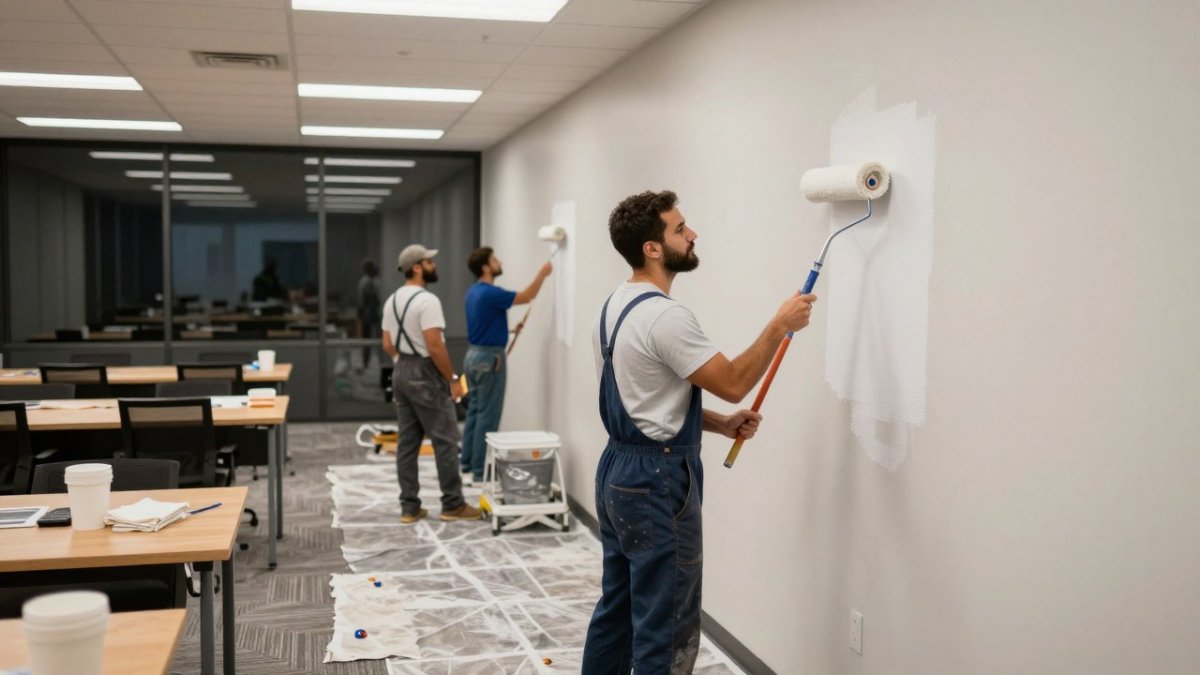
After-hours and weekend painting lets a business stay open while the work gets done. Crews paint outside business hours, then reset the space before staff return.
Your Commercial Painting Scheduling Checklist
A commercial painting scheduling checklist keeps every date, contact, and access detail in one place. Use it to confirm the plan before you book. Run through it with your contractor.
- Site assessment completed and documented
- Written scope approved, including exclusions
- Detailed estimate reviewed and signed
- Start date and completion date agreed
- Phased schedule mapped by work zone
Keep this list current. A schedule that lives in one shared document beats dates spread across emails and texts.
Contingencies, Phased Work, and Occupant Safety
Contingencies are the backup plans that keep a painting schedule from collapsing when something changes. Build them into the plan before work starts. Change happens on most occupied-building jobs, and the difference between a smooth project and a chaotic one is whether the change was anticipated in writing.
Schedule Contingencies and Change Management
Plan for these common shifts and decide in advance how each will be handled:
- Weather and humidity. Rain and damp air slow drying, especially on exterior-adjacent walls and in unheated spaces. Build one to two days of slack into any work that depends on exterior conditions, and confirm the contractor's drying-time assumptions for the products specified.
- Scope changes. New requests get priced and scheduled in writing, not squeezed in. A written change order should state the added work, the revised dates, and any cost impact before the crew proceeds.
- Material lead times. Specialty coatings, custom colors, and some low-odor or fast-cure products may not be stocked locally. Confirm lead times at booking, not the week before the start date.
- Crew or equipment delays. A confirmed backup date protects your completion expectations. Ask the contractor how they handle a crew shortage or equipment failure and what notice you will receive.
- Occupant needs. A surprise event, audit, or busy day may require moving a zone. Agree on a minimum notice period for zone changes and who has authority to approve them.
A common pattern is to hold a short weekly check-in with the contractor's project lead and your internal point of contact. Fifteen minutes is enough to confirm the next week's zones, flag any access conflicts, and update the shared schedule document.
How to Build a Phased Schedule for an Occupied Building
Phased work can help keep occupied buildings running. Painting one zone at a time and reopening it before moving to the next is a common approach.
A workable sequence looks like this:
- Map zones by function, not just by floor. Group rooms that share an access route or a quiet-hours requirement so the crew is not crossing active areas repeatedly.
- Define the access route for each phase. Mark the path the crew will use to move materials and equipment, and confirm it does not pass through a zone that is still wet or occupied.
- Set curing and reopening criteria. Decide how long a zone stays closed after the final coat, based on the product's recoat and cure times and on ventilation. Do not reopen a zone until the contractor confirms it is dry to the touch and safe for occupancy.
- Reopen before you move on. Inspect and reopen each zone before the next phase begins, so the building never has more than one closed area at a time.
- Keep a shared zone tracker. A simple table listing each zone, its planned dates, its actual dates, and its reopening status keeps everyone aligned.
Safety, Ventilation, Odor, and Occupant Protection
Occupant safety matters just as much as schedule. Confirm ventilation in each work area, keep occupants out of wet zones, and protect anyone with sensitivity to paint odor.
Common controls for occupied-building work include:
- Barriers and signage. Use plastic sheeting or temporary partitions to separate work zones from occupied areas, and post signs at every entrance to a wet zone.
- Ventilation. Confirm that each work area has adequate airflow during and after painting. In enclosed spaces, the contractor should specify how air will be moved.
- Safe access. Crews should keep walkways clear, store materials safely, and never block exits or fire equipment.
- Occupant communication. Notify staff and tenants before each phase, including which areas will be closed and when they will reopen.
For a standard planning document, use a painting scope of work template to capture these details.
Reopening a zone too early can create safety and quality problems on occupied jobs. Paint that feels dry can still off-gas or transfer, so confirm reopening criteria with the contractor in writing before occupants return.
Request a Written Scope and Free Estimate Before You Book
A written scope and free estimate protect you from surprise charges and shifting dates.
Ask your contractor for:
- A written scope that lists included and excluded work
- A detailed estimate tied to that scope
- A phased schedule with dates and access windows
- A named point of contact for the project
At LMJ Bright Painting Services, a written scope is provided before scheduling or payment.
When you are ready to move forward, tell us what you would like painted and request a written estimate.
Scheduling a commercial painting project without shutting down your business takes planning, and the details decide whether it goes smoothly.
Frequently Asked Questions
How far in advance should you schedule a commercial painting project?
Book ahead of your target start date, since contractor calendars can fill quickly. Lock a start date before you finalize budget planning. A site assessment and written scope should come first, because contractor availability depends on the size of the job and how much prep your walls need.
How can a business schedule painting without disrupting operations?
Split the work into phases and tie each phase to a work zone rather than the whole building. Schedule noisy prep and odor-heavy coatings during off-hours, keep customer-facing areas painted last, and post courtesy notifications for employees and tenants a week ahead. A commercial painting scheduling checklist with named points of contact on both sides keeps access windows and daily expectations clear.
How long does a commercial painting project usually take?
Project length depends on the size and scope of the space and how the work is phased. Timeline length depends on square footage, drying time between coats, how many work areas you release at once, and weather if exterior surfaces are involved. Ask for a completion date per phase, not just one overall date.
What should be included in a commercial painting schedule?
List the start date and completion date for each phase, access windows and off-hours access, work areas and who clears them, the point of contact for tenants and employees, coating products and dry times, and a contingency window for weather or change orders. A written scope from the contractor should sit alongside it so pricing and project requirements match what gets scheduled.