 How-to
7 Commercial Painting Project Management Tips That Work
Last Updated: November 5, 2026
Quick Summary
Effective commercial painting project management starts with a written scope of work that defines every surface, prep step, coating, and protection requirement before work begins. Build the schedule backward from your operating hours, budget from measured quantities, and track progress with a zone tracker and phase-gate inspections.
- A written change-order procedure prevents hidden-issue surprises by pricing fixes in writing before work continues.
- Schedule zones so revenue-generating areas finish first, with after-hours windows for high-traffic spaces.
- Separate labor, materials, protection, and contingency in the budget so you can see where money goes.
- Schedule inspections at prep, first coat, and final so failures are caught while the crew is still mobilized.
- Closeout includes punch-list signoff, maintenance guidance, and a lessons-learned review to size future contingency.
Table of Contents
- Commercial Painting Project Planning Starts With a Written Scope
- Building a Commercial Painting Project Schedule Around Business Hours
- How to Set a Commercial Painting Project Budget Without Surprises
- Your Commercial Painting Preparation Checklist for Day One
- Coordinating Contractors, Crews, and Building Occupants
- Risk, Safety, and Compliance Controls That Protect the Schedule
- Tracking Progress, Quality, and the Final Punch List
- Build Your Free Estimate Before the First Can Opens
- Frequently Asked Questions
Commercial Painting Project Planning Starts With a Written Scope
A commercial painting project succeeds or fails on paper before a brush ever touches a wall. Occupied offices and rental turnovers often go sideways when nobody writes down what "done" actually means. A written scope is the foundation of every commercial painting project management plan.
A commercial painting project scope of work is a written document that defines every surface to be painted, the prep and coating specified for each, the protection required, and the conditions for completion. It converts a verbal promise into a shared reference both sides can point to.
What Belongs in the Scope of Work
A scope that survives contact with reality includes:
- Room-by-room or work-zone surface list (walls, ceilings, trim, doors, cabinets)
- Prep steps per surface: patching, sanding, caulking, priming
- Coating type, sheen, and number of coats
- Protection plan for floors, furniture, and equipment
That last bullet matters more than most owners realize. A written change-order procedure is what prevents the "hidden issues" surprise. If a substrate reveals rot or a failing previous coating, the fix gets priced and approved in writing before work continues.
Why a Site Survey Comes Before Any Number
No credible estimate exists without a site survey. A walkthrough confirms ceiling heights, substrate condition, access constraints, and how much protection and labor the job truly needs. Skipping it is how quotes turn into change orders.
For teams drafting their own documents, our standardized painting scope of work template gives you a starting structure to model.
Building a Commercial Painting Project Schedule Around Business Hours
The best commercial painting project schedule is built backward from your operating hours, not the crew's convenience. Most commercial clients cannot shut down. So scheduling starts with one question: which zones can we hand over, and when?
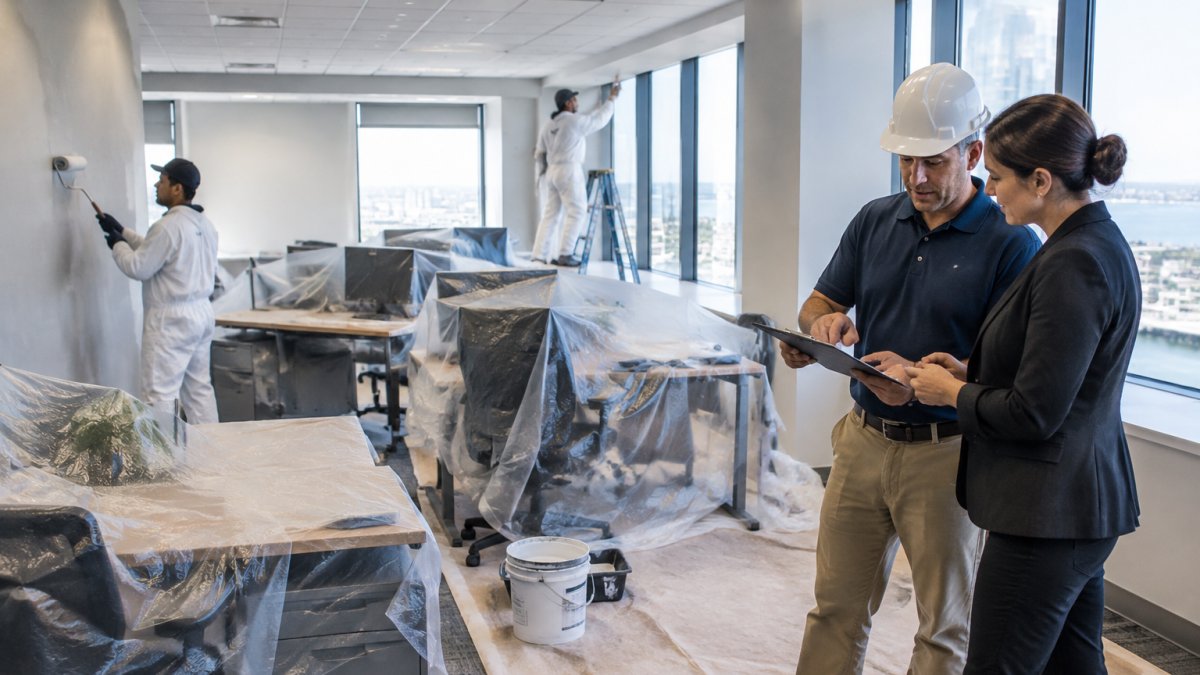
A workable schedule typically runs in phases:
- Confirm blackout dates and busy periods with the facility manager
- Sequence zones so revenue-generating areas finish first
- Assign after-hours or weekend windows to high-traffic spaces
- Build in cure and dry time between coats and before furniture returns
- Reserve buffer days for weather delays on exterior work and inspection findings
For occupied buildings, phased after-hours work is often the only path to minimal disruption. Our after-hours commercial painting planning guide walks through the sequencing in more detail.
How to Set a Commercial Painting Project Budget Without Surprises
A commercial painting project budget holds when it is built from measured quantities, not guesses.
Budget management starts with a cost estimate tied to real measurements. Then add a contingency line for unknowns: substrate repair, extra coats, or access equipment.
Watch out: a quote with no line-item breakdown is not a budget, it is a hope. Ask for the scope and quantities behind every number.
To turn your own room or wall measurements into preliminary planning ranges, our free interior painting cost estimator calculates labor, paint quantity, and state-adjusted figures before you commit.
Your Commercial Painting Preparation Checklist for Day One
Site preparation protects the building and the schedule. A commercial painting preparation checklist keeps the crew and the facility team aligned from the first morning.
- Confirm zone handover and occupant notifications
- Move and cover furniture, equipment, and fixtures
- Protect floors, stair rails, and door hardware
- Set up containment and negative air if dust is a concern
Surface preparation is where quality is won. Careful preparation and protection of surfaces is part of how LMJ Bright Painting Services approaches each project.
Coordinating Contractors, Crews, and Building Occupants
Contractor coordination is a communication problem before it is a scheduling problem. The facility manager needs one point of contact, one daily update, and one channel for questions.
Set expectations up front:
- Clear points of contact for questions
- A short daily status note: zones complete, zones active, issues
- A single approval path for change orders
- Clear rules for occupant access and noise windows
Crew supervision keeps quality consistent across phases. When the same supervisor owns the job start to finish, punch lists shrink. Our guide to direct communication with your painting contractor explains how to keep that channel open.
Risk, Safety, and Compliance Controls That Protect the Schedule
Risk management on a commercial painting project is largely about the things that can stop work: safety incidents, failed inspections, weather, hidden substrate damage, material shortages, access restrictions, and scope changes. The strongest project managers do not just react to these events, they size contingency time and budget for them before the first can opens.
Build a Risk Register Before Mobilization
A simple risk register turns vague worry into an owned action. For each risk, record the trigger, the likely schedule impact, the likely cost impact, the owner, and the response. A workable register for a commercial repaint typically covers:
- Weather delays on exterior work, track forecast windows and hold exterior buffer days rather than promising a date the sky can break.
- Hidden surface damage, rot, failing previous coatings, or water damage found after prep begins. Price the repair only after in-person verification.
- Material shortages or backorders, confirm product lead times before committing to a start date, and identify an approved equal product in the specification so a substitution does not stall the schedule.
- Access restrictions, locked suites, freight-elevator windows, badge requirements, and loading-dock hours. Confirm these during the site survey, not on day one.
- Scope changes, added rooms, upgraded sheens, or newly discovered surfaces.
Size Contingency in Time and Money
Contingency is not padding, it is a planned reserve tied to the risk register. Most practitioners find that exterior work needs weather buffer days built into the schedule, and that a contingency line in the budget should be sized to the unknowns the site survey actually surfaced. A common pattern is to separate contingency for substrate repair from contingency for schedule slippage, so the two do not quietly consume each other.
Safety and Compliance Specifics
Safety standards to enforce on every site:
- Safety data sheets for the coatings used, available on site
- Adequate ventilation and respiratory protection where required
- Fall protection for any elevated work
- Lockout and containment around occupied electrical and HVAC zones
- Hazard assessment completed before each phase, not once at the start
Compliance specifics belong in the contract. Confirm the building's age and any known hazardous-material reports during the site survey, and follow applicable requirements before sanding or scraping.
Inspection and Weather Controls
Failed inspections and weather are the two most common schedule breakers on exterior and occupied work. Schedule inspections at phase gates, prep, first coat, final, so a failure is caught while the crew is still mobilized rather than after demobilization. For exterior work, hold buffer days and communicate a weather decision rule to the client up front: if the forecast crosses a defined threshold, the exterior phase slips by the buffer, not by an open-ended delay.
Tracking Progress, Quality, and the Final Punch List
Progress tracking turns a verbal "almost done" into a measurable status.
Measurable Project Controls
Use a zone tracker as the backbone: not started, in progress, first coat complete, final coat complete, inspected. Layer these indicators on top of it:
- Schedule variance, planned zones complete versus actual zones complete at each phase gate. A widening gap is the earliest signal that buffer days will be consumed.
- Budget variance, committed cost versus budget by line (labor, materials, protection, contingency). Track it weekly, not at the end.
- Rework, square footage or zones repainted because of coverage, sheen, or cut-line failures. Rising rework is a supervision problem, not a crew problem.
- Inspection pass rate, the share of phase-gate inspections passed on the first attempt. A falling rate predicts a larger punch list.
- Disruption incidents, occupant complaints, blocked egress, noise-window violations, or missed handovers. Log every one; patterns point to a sequencing fix.
Quality Control at Three Checkpoints
Quality control happens at three checkpoints:
- Prep inspection before the first coat
- Mid-project check on sheen, coverage, and cut lines
- Final walkthrough with the client and supervisor together
Closeout: Punch List, Warranty, and Handover
The final walkthrough produces the punch list: touch-ups, missed spots, and hardware reinstallation. Closeout is more than closing the punch list, it is the documented handover that protects both sides after the crew leaves:
-
Punch-list signoff, every item closed and signed by the client before final payment and before the space reopens.
-
Maintenance guidance, cleaning method, recoat interval, and the sheen or product to use for future touch-ups.
-
Lessons learned, a short internal review of what the risk register got right and what it missed, so the next project's contingency is sized better.
These are the measurable controls the article recommends layering on top of a zone tracker.
| Control | What it measures | Note |
|---|---|---|
| Schedule variance | Planned zones complete versus actual zones complete | Track at each phase gate |
| Budget variance | Committed cost versus budget by line | Track it weekly, not at the end |
| Rework | Square footage or zones repainted | Rising rework is a supervision problem |
| Inspection pass rate | Share of phase-gate inspections passed first attempt | A falling rate predicts a larger punch list |
| Disruption incidents | Complaints, blocked egress, noise-window violations, missed handovers | Log every one |
Build Your Free Estimate Before the First Can Opens
Good commercial painting project management comes down to written scope, measured budget, phased schedule, and documented closeout.
LMJ Bright Painting Services is a veteran-owned company built around exactly that discipline. Our commercial interior painting service covers offices, retail spaces, and phased work zones.
Get started with LMJ Bright Painting Services and build a free estimate that puts your scope, schedule, and budget in writing before the first can opens.
Frequently Asked Questions
What does a commercial painting project manager actually do?
A project manager owns the written scope, the schedule, and the budget from the first walkthrough to the punch list. That means running the site survey before pricing, ordering materials so crews are not idle, coordinating access with building occupants, and inspecting each coat as it goes up. On a commercial painting job, the manager is also the single point of contact for change requests, so nothing gets added verbally and billed later. Ask who that person is before you sign.
How do you keep a commercial painting project on budget?
Start with a cost estimate built from an in-person site survey, not a square-foot guess over the phone. Separate labor and materials in the quote so you can see what a change actually costs. Hold a contingency line for surface repairs found after prep begins. Then track change orders in writing: any added work gets a price and a signature before it proceeds. A commercial painting project budget only holds when the scope is fixed and changes are documented, not negotiated at the end.
How do you schedule a commercial painting project without disrupting business?
Split the space into work zones and paint them in sequence so staff can keep operating in untouched areas. Confirm access requirements up front: after-hours entry, elevator use, loading dock time, and where crews park. Publish the work schedule a week ahead so occupants know which rooms are off limits and when. Build weather delays and cure time into the timeline rather than assuming perfect conditions. A schedule that names zones and hours is far easier to hold than one that says 'two weeks.'
What should be included in a commercial painting preparation checklist?
List surface preparation before anything else: washing, patching, sanding, and priming every substrate from drywall to metal trim. Add protection for furnishings, flooring, and equipment, plus masking of fixtures and signage. Note access needs, ventilation, and any safety standards the site requires. Then confirm paint selection and coating specifications by area, since a restroom wall and a warehouse wall need different products. A preparation checklist that covers surfaces, protection, and products prevents most callbacks.
If your next commercial project needs a plan you can trust, start with a written scope and a verified walkthrough.