 How-to
How to Choose Exterior Paint Colors for Curb Appeal
Last Updated: October 23, 2026
Quick Summary
To choose exterior paint colors for curb appeal, start with the fixed materials you cannot change cheaply: the roof, brick, stone, and architecture. Build a coordinated whole-house plan assigning body, trim, accent, and front door colors, then test large two-foot samples on two sides of the house at three times of day before ordering paint.
- Keep the body color lighter than the roof and let the front door carry the boldest color.
- Paint samples at least two feet square, apply two coats, and check them morning, midday, and late afternoon.
- Use a visualizer to shortlist whole palettes, then confirm with real samples on the wall.
- Warm shingles want warm undertones and cool shingles want cool undertones.
- Confirm HOA or historic district approval in writing before scheduling any painting work.
Table of Contents
- Start With a Step-by-Step Exterior Paint Color Selection Process
- Proven Exterior Paint Color Combinations for Siding, Trim, and Front Door
- How to Test Exterior Paint Colors Before You Commit
- Use an Exterior Paint Color Visualizer the Right Way
- How Daylight, Orientation, and Surrounding Light Change Paint Appearance
- Match Paint to Architectural Style, Stone, Brick, and Roof
- Neighborhood Rules, Historic Districts, and Climate Durability
- Common Mistakes to Avoid When Choosing Exterior Paint Colors
- Frequently Asked Questions
Start With a Step-by-Step Exterior Paint Color Selection Process
Choosing exterior paint colors for curb appeal works best as a process, not a shopping trip. At LMJ Bright Painting Services, we treat color selection the same way we treat a project scope: define the fixed pieces first, then build the plan around them. That order prevents the most common and most expensive mistake, which is falling for a color in a store and discovering on the wall that it fights the roof.
Here is the sequence we walk homeowners through before any paint is ordered.
Step 1: Assess Your Home's Fixed Materials and Architecture
Start with what cannot change cheaply: the roof, brick, stone, and the shape of the house. These set the limits for everything else.
- Roof: Note whether the shingles read warm (brown, terracotta) or cool (charcoal, slate).
- Masonry: Brick and stone carry their own undertones that siding must respect.
- Architecture: A Craftsman bungalow and a mid-century ranch call for different palettes.
- Trim depth: Deep trim shows color differently than flat, narrow trim.
Write these down. You now have a filter for every color you look at.
Step 2: Build a Coordinated Whole-House Color Plan
A coordinated whole-house color plan assigns a job to each surface before you pick a single shade. Most homeowners pick a body color first and then scramble for trim and door colors. Reverse it.
Plan three to five colors as a system: body, trim, accent, front door, and shutters if you have them. Decide the contrast level between body and trim up front. Low contrast reads soft and modern; high contrast reads crisp and traditional. That one decision narrows your options faster than any swatch fan.
Proven Exterior Paint Color Combinations for Siding, Trim, and Front Door
Certain exterior paint color combinations keep working because they balance warm and cool tones instead of letting one dominate.
| Body | Trim | Front Door | Best For |
|---|---|---|---|
| Warm off-white | Soft white | Deep navy | Brick and stone homes |
| Light warm gray | Bright white | Black or charcoal | Modern and transitional |
| Beige or greige | Cream | Burgundy or forest green | Traditional and ranch |
| Slate blue-gray | White | Natural wood tone | Coastal and Craftsman |
| Sage green | Off-white | Warm brown | Cottage and bungalow |
| Putty or taupe | Crisp white | Oxblood or teal | Tudor and cottage |
| Soft butter yellow | White | Black or slate blue | Farmhouse and cottage |
A few rules make these combos work. Keep the body color lighter than the roof.
Neutral tones, whites, grays, and beiges, are the safest base because they age well and support resale appeal. That does not mean boring.
When you build a palette, assign each surface a job before you shop.
If you are working with existing stone or brick, pull a mid-tone from the masonry and use it as your guide. Warm brick wants warm siding; cool stone wants cool or neutral siding.
For a classic scheme, stay within one color family and vary lightness: a light body, medium trim, and dark door.
How to Test Exterior Paint Colors Before You Commit
Testing is the step most people skip, and it is the step that saves the most regret. Store lighting lies. Your exterior wall, lit by sun and bounced light from the driveway, will show a color differently than the chip in your hand.
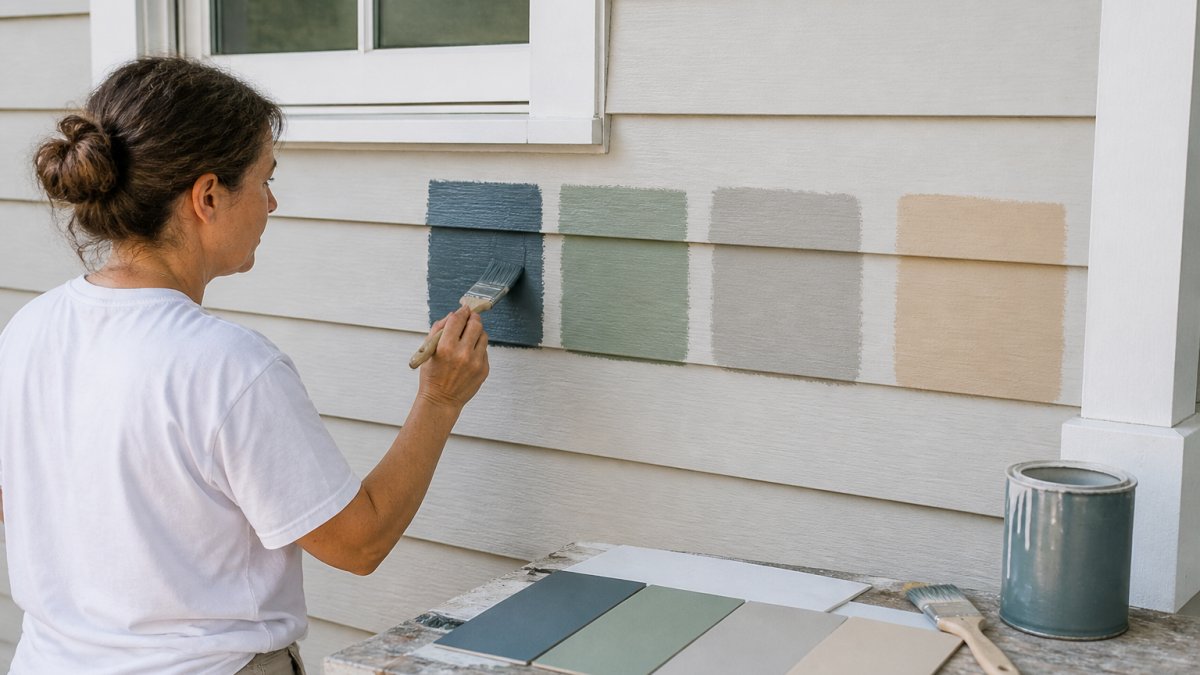
Here is how to test exterior paint colors properly:
- Paint large samples, at least two feet square, directly on the wall.
- Place them on at least two sides of the house, one sunny and one shaded.
- Apply two coats so the sample reads true.
- Look at them at three times of day: morning, midday, and late afternoon.
- Check them against the roof, trim, and any brick or stone nearby.
Small dabs of color are useless outdoors. Large samples are the only honest test.
Use an Exterior Paint Color Visualizer the Right Way
An exterior paint color visualizer is a tool that lets you preview colors on a photo of your home before buying paint. It is genuinely useful, but only if you treat it as a shortlist tool, not a decision-maker.
The right way to use one:
- Upload a clear, straight-on photo of your house in daylight.
- Test whole palettes, not single colors, so you see how body, trim, and door interact.
- Compare two or three finalists side by side.
- Take your shortlist to real paint samples on the wall.
Visualizers get you from dozens of options down to a few. They cannot account for the light on your specific street, which is why the physical sample still matters.
How Daylight, Orientation, and Surrounding Light Change Paint Appearance
The same exterior paint color can look like three different colors on three sides of one house. Orientation drives this. A wall facing the morning sun reads brighter and warmer. A shaded wall pulls cooler and can turn blue or gray.
Surrounding light matters too. A driveway, a lawn, a neighboring wall, or a row of trees bounces color onto your siding. A white house next to dense green landscaping picks up a green cast. A house beside a warm brick neighbor can look cooler by contrast.
Sun exposure also affects how long a color lasts. South and west walls take the hardest UV hit, and dark colors absorb more heat and fade faster in strong sun.
Match Paint to Architectural Style, Stone, Brick, and Roof
Paint should look like it belongs on that house. Architectural style gives you the palette; existing materials give you the undertones.
- Craftsman and bungalow: earthy greens, warm browns, cream trim.
- Colonial and traditional: whites, soft grays, navy or black doors.
- Mid-century and ranch: warm grays, beige, muted earth tones.
- Coastal: soft blues, whites, sandy neutrals.
For stone and brick, pull a mid-tone straight from the masonry and use it as your guide. If the brick is warm, keep the siding warm. Cool siding against warm brick creates a clash the eye catches instantly. Match the roof's undertone the same way. Color coordination with existing materials is not a style preference; it is what makes a house look finished.
Neighborhood Rules, Historic Districts, and Climate Durability
Before you buy paint, check whether your neighborhood or city restricts exterior colors. Historic districts often require approval for color changes, and some HOAs publish approved palettes. Skipping this step can mean repainting at your own cost.
Here is a practical way to check:
- Ask your HOA for its architectural review guidelines and any approved color list. Many HOAs require written approval before painting, even if the color is on the list.
- Call your local planning or historic preservation office if your home is in a historic district or overlay. Ask whether exterior color changes need a certificate of appropriateness or a staff-level review.
- Request the review timeline in writing. Approval can take weeks, and scheduling painters before approval risks missed dates.
- Keep a copy of the approval with your project file. It protects you if a neighbor or inspector questions the color later.
Climate matters just as much. In hot, humid, sun-heavy climates, paint faces intense UV and moisture. Lighter colors reflect heat and hold their appearance longer.
Proper surface prep matters more than the color itself for durability, because paint fails at the prep line, not the pigment.
Moisture is the other durability factor. In humid climates, paint needs to breathe and shed water. Skipping primer or painting over chalky or dirty siding traps moisture and leads to peeling.
A simple rule: choose the color for appearance, but confirm it for rules and performance. The best exterior paint color is the one that fits your fixed materials, survives your local light and climate, and clears any neighborhood rules. Style comes after those three.
Common Mistakes to Avoid When Choosing Exterior Paint Colors
Most disappointing paint jobs trace back to a handful of avoidable errors. Watch for these.
- Picking from a chip indoors. Always test on the wall in daylight.
- Choosing the body color first. Build the whole-house plan before committing.
- Ignoring the roof and brick. They set the undertone rules.
- Too many colors. Three to four is plenty; more looks busy.
- Skipping the rules check. HOA and historic approvals come first.
- Skipping prep in the quote. Color cannot fix peeling or poor prep.
A methodical approach beats a trendy one. Get the process right and the color choice becomes far easier.
Choosing exterior paint colors is really a planning problem, and planning is where a project succeeds or fails. LMJ Bright Painting Services brings a veteran-owned, structured approach to every job: room-by-room and work-zone planning, in-person verification before final pricing, and a written scope before scheduling or payment so you know exactly what is included. Our free smart estimator gives you a transparent starting point, and you get direct phone and message access to the owner.
Frequently Asked Questions
How many exterior paint colors should I use on a house?
Most homes look best with three colors: a main body color for the siding, a trim color for fascia and window frames, and an accent color for the front door or shutters. A fourth shade is acceptable when your home has distinct architectural details like a porch ceiling or gable. Keeping the palette to three or four colors creates a coordinated look without visual clutter. If you are unsure, pick the body color first, then choose trim and accent shades that share its undertone.
How do I test exterior paint colors before painting the whole house?
Paint large sample boards or patches directly on the siding in at least two separate areas of the house. Apply two coats so the color reads accurately, then view the samples at different times of day: morning, midday, and late afternoon. Check them against your roof, stone, and landscaping. Avoid judging from tiny paper swatches, since exterior paint colors shift significantly under direct sun, shade, and reflected light from nearby surfaces.
What exterior paint colors make a house look expensive?
Deep, saturated colors and muted neutrals tend to read as higher-end than bright or high-contrast schemes. Examples include charcoal gray, deep navy, sage green, and warm off-white paired with dark trim. The finish matters too: a consistent sheen across siding and trim looks intentional, while mismatched finishes look cheap. Coordinating your exterior paint colors with existing stone, brick, and roof tones adds the polished, cohesive look buyers associate with a well-maintained home.
Can I use an exterior paint color visualizer instead of testing samples?
A visualizer is a useful first step for narrowing options, but it cannot replace physical samples. Digital tools render colors on a flat screen under simulated light, so the result rarely matches how paint looks on your actual siding. Use the visualizer to shortlist two or three exterior paint color combinations, then test each one on the house before committing. The combination of digital preview and real-world samples gives you the most reliable result.