 Listicle
6 Best Primers for High Humidity Interior Walls
Last Updated: November 19, 2026
Quick Summary
The 6 best primers for high humidity interior walls are Zinsser Perma-White, KILZ Kitchen & Bath, KILZ Adhesion, INSL-X Water Based Bonding Primer, Zinsser BIN, and Zinsser Mold Killing Primer. The strongest choices combine mold resistance with stain blocking and suit bathroom and kitchen walls. Choose by room, surface, and stain condition, and repair any moisture source before priming.
- Zinsser Perma-White carries an explicit mold- and mildew-proof claim on its label.
- KILZ Kitchen & Bath combines stain blocking with mildew resistance for kitchens and bathrooms.
- Zinsser BIN is shellac-based and the strongest stain blocker here, but needs ventilation.
- No primer in the list is a vapor barrier, so active leaks must be fixed first.
- Clean soap film and mildew, then let the surface dry completely before priming.
Table of Contents
- Why High-Humidity Walls Need a Different Primer
- How We Selected and Ranked These Six Primers
- The 6 Best Primers for High Humidity Interior Walls
- Moisture-Resistant Primer for Bathroom Walls: What to Look For
- Best Primer for Bathroom Ceiling and Room-by-Room Choices
- KILZ Kitchen and Bath Primer: When It Fits Your Project
- Booking a Humidity-Ready Paint Plan With LMJ Bright Painting
- Frequently Asked Questions
Painting a bathroom or humid interior wall with the wrong primer can mean peeling paint, bleeding stains, and returning mildew, which is why choosing from the 6 best primers for high humidity interior walls matters so much. The answer is a primer with strong adhesion, stain blocking, and some mildew resistance. This guide covers six primers that fit that profile, how we judged them, and how to choose.
Why High-Humidity Walls Need a Different Primer
A primer prepares a surface for paint. In a dry room, almost any quality primer will do. In a bathroom, laundry room, or kitchen, moisture from showers and cooking condenses on cool walls and lingers, loosening poorly bonded paint and feeding mildew.
The practical difference comes down to three things: the primer must grip the surface, block stains from water or old finishes, and resist growth that thrives in damp conditions. Ventilation matters too, a bathroom fan run only a few minutes after a shower leaves surfaces wet far longer than most homeowners expect.
How We Selected and Ranked These Six Primers
Before buying, read the label and check it against your wall type and room conditions.
The 6 Best Primers for High Humidity Interior Walls
Below is a ranked comparison of six primers for high-humidity interior walls, reflecting how well each product's labeled purpose, substrate compatibility, and moisture-related claims match bathrooms, laundry rooms, kitchens, and basements. Because manufacturers do not publish a standardized humidity-resistance rating, the comparison leans on three criteria: explicit mold or mildew resistance on the label, stated suitability for interior high-moisture areas, and compatibility with bare drywall, previously painted drywall, plaster, and stain-blocking scenarios. Always confirm the current label before buying.
1. Zinsser Perma-White Mold & Mildew-Proof Primer
Perma-White is the most frequently cited option when mold resistance is the primary concern. The label identifies it as a mold- and mildew-proof interior primer-sealer. It is water-based, so it cleans up with soap and water and has lower odor than solvent-based alternatives in a small bathroom.
Pros:
- Explicit mold- and mildew-proof claim on the label.
- Water-based formula suitable for interior use.
- Can be tinted, which reduces the number of topcoats needed over dark surfaces.
Cons:
- Not a dedicated stain-blocking primer; heavy water stains may need a separate blocker first.
- Reported pricing varies by retailer and package size.
Best for: Bathroom ceilings, shower walls, and other surfaces where mold resistance is the top priority. Skip if: you are priming bare wood or metal, where a specialty primer is a better fit.
2. KILZ Kitchen & Bath Primer
KILZ Kitchen & Bath is formulated specifically for interior rooms with high moisture and grease exposure. The label positions it for kitchen and bathroom walls and ceilings, combining stain blocking with a mildew-resistant film. It is water-based and bonds to previously painted drywall, plaster, and masonry. This is the product most readers will want when the wall has cooking residue, soap scum, or light water staining in addition to humidity.
Pros:
- Purpose-built for kitchen and bath environments.
- Combines stain blocking with mildew resistance.
- Bonds to a range of interior substrates.
Cons:
- Not intended as a vapor barrier; it does not stop moisture migration through the substrate.
- Requires a clean, dry surface, grease or soap film will compromise adhesion.
Best for: Kitchen walls near the range, bathroom walls with light staining, and laundry rooms. Skip if: the wall has active leaks or heavy water damage, which must be repaired before any primer is applied.
3. KILZ Adhesion High-Bonding Primer
KILZ Adhesion is an adhesion-focused primer rather than a moisture-specific one. Its value in a humid room is indirect but real: where paint fails in bathrooms, the failure is often peeling from poor bonding over glossy or previously painted surfaces. It bonds to hard-to-stick surfaces including glossy paint, tile, and laminate, but carries no mold-resistance claim, so pair it with a mold-resistant topcoat in a shower area.
Pros:
- Strong bond to glossy and slick surfaces.
- Water-based and low-odor.
- Useful as a problem-solver over old, well-bonded paint.
Cons:
- No explicit mold or mildew resistance on the label.
- Not a stain blocker.
Best for: Glossy or previously painted walls where peeling is the concern. Skip if: mold resistance is the primary requirement.
4. INSL-X Water Based Bonding Primer
INSL-X Water Based Bonding Primer is another adhesion-first product. It is commonly used over difficult substrates and as a bridge coat before topcoating, and in a humid interior it is most useful on walls that have been patched, skim-coated, or previously coated with a slick finish. Like KILZ Adhesion, it carries no mold-resistance claim, so it is a preparation tool rather than a moisture solution.
Pros:
- Water-based and low-odor.
- Strong bond to patched and slick surfaces.
- Compatible with most latex topcoats.
Cons:
- No mold or mildew resistance claim.
- No published humidity-exposure limit.
Best for: Patching and skim-coat areas before a mold-resistant topcoat. Skip if: you need a single product that addresses both adhesion and mold.
5. Zinsser BIN Shellac-Based Primer
BIN is a shellac-based primer-sealer and the strongest stain blocker in this group. In a humid room, its role is to seal water stains, smoke residue, and old finish bleed-through that water-based primers can let migrate. The trade-off is solvent odor and cleanup with denatured alcohol, so ventilation during application is essential.
Pros:
- Excellent stain blocking for water and smoke stains.
- Fast dry and recoat time.
- Bonds to most interior substrates.
Cons:
- Strong solvent odor; ventilation is mandatory.
- Not a mold-resistance product on its own.
- Higher cost per gallon than water-based options.
Best for: Sealing water stains on ceilings and walls before a mold-resistant topcoat. Skip if: the room cannot be ventilated during application.
6. Rust-Oleum Zinsser Mold Killing Primer
Zinsser Mold Killing Primer is a water-based primer that combines a mold-killing claim with primer-sealer function. It is intended for surfaces that have had surface mold or mildew, and is commonly used on drywall, plaster, and masonry. It is not a substitute for removing active mold or fixing the moisture source, but it is a reasonable first coat on a wall that has been cleaned and dried.
Pros:
- Mold-killing claim on the label.
- Water-based and low-odor.
- Bonds to common interior substrates.
Cons:
- Does not address the underlying moisture source.
- Not a heavy stain blocker.
Best for: Previously mold-affected walls after cleaning and drying. Skip if: the wall still has active growth or visible moisture.
How the Six Compare at a Glance
| Primer | Mold claim | Stain blocking | Best substrate | Typical use |
|---|---|---|---|---|
| Zinsser Perma-White | Yes | Light | Drywall, plaster | Bathroom ceilings and shower walls |
| KILZ Kitchen & Bath | Yes | Moderate | Drywall, plaster, masonry | Kitchen and bath walls |
| KILZ Adhesion | No | No | Glossy paint, tile, laminate | Peeling-prone painted walls |
| INSL-X Bonding Primer | No | No | Patched and slick surfaces | Prep coat before topcoat |
| Zinsser BIN | No | Heavy | Most interior substrates | Water and smoke stain sealing |
| Zinsser Mold Killing Primer | Yes | Light | Drywall, plaster, masonry | Previously mold-affected walls |
Watch out: no primer on this list is a vapor barrier. If moisture is migrating through the wall from outside or from a leak, a primer will not stop it, the source must be repaired first.
manufacturer label and safety data sheets
Moisture-Resistant Primer for Bathroom Walls: What to Look For
Most primers marketed for bathrooms make similar claims, so the useful question is not whether a product says "moisture-resistant" but what the label actually specifies.
**1.
2. Substrate compatibility. Bare drywall, previously painted drywall, plaster, masonry, and glossy finishes each behave differently.
3. Stain-blocking capability. Water stains, smoke residue, and old finish bleed-through are common in bathrooms and kitchens. Water-based primers block light stains; shellac-based primers block heavy ones.
**4.
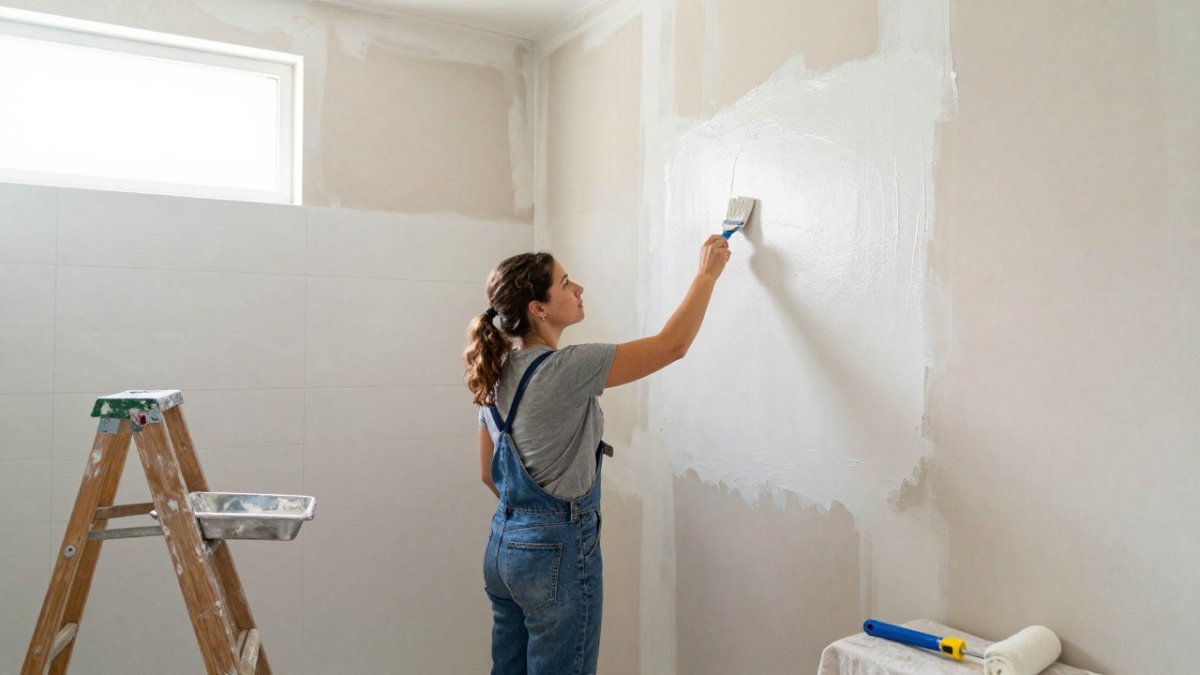
Preparation matters as much as the product. Remove loose paint, clean off soap film and mildew with a detergent solution, rinse, and let the surface dry completely before priming.
Diagnose the moisture source first. Primer cannot fix an active leak, a failed caulk joint, or condensation from a missing exhaust fan.
Room-by-room moisture conditions. Bathrooms combine steam and direct water spray; kitchens combine grease with steam; laundry rooms combine sustained humidity with lint; basements combine cool surfaces with ground moisture.
Best Primer for Bathroom Ceiling and Room-by-Room Choices
Bathroom ceilings take the most abuse because steam rises and collects there, so a mold-resistant option is usually the safer choice overhead. Kitchens need stain blocking for grease and cooking residue, laundry rooms benefit from a primer that bonds well to a range of surfaces, and basements often need a dedicated moisture-barrier product, check before relying on a standard primer.
Match the primer to the room, the surface, and the problem you are solving. A single product rarely covers every need in a home.
KILZ Kitchen and Bath Primer: When It Fits Your Project
KILZ Kitchen and Bath Primer is a common name in humid-room projects. However, our research did not include verified details for this product, including its formulation, price, or humidity rating. Treat any claim about it with caution until you check the manufacturer's label.
If you are considering it for a kitchen or bath, confirm three things on the label: that it is designed for interior use in high-moisture areas, that it addresses mildew, and that it is compatible with the topcoat you plan to use. Those details will tell you more than any general description.
Booking a Humidity-Ready Paint Plan With LMJ Bright Painting
Choosing the right primer is only one part of a successful project. If you would rather have a plan built around your home, LMJ Bright Painting Services can walk through your project with you before any work begins.
Start by exploring kitchens, bathrooms and living rooms in 3D with the colors and surfaces you are considering. Then review the interior painting services that cover walls, ceilings, trim, and closets for homes and rental properties. If you are managing a rental, our rental repaint planning checklist covers surfaces, access, colors, quotes, and the final walkthrough. For moisture or mold concerns, read our notes on moisture, mold and indoor air before you prime.
LMJ Bright Painting Services provides a written scope before scheduling or payment, and verifies the job in person before final pricing. Build a free estimate to see what a humidity-ready paint plan would include for your space.
Frequently Asked Questions
What is the best primer for high-humidity interior walls?
For high-humidity interior walls, look for a water-based primer labeled as mold- or mildew-resistant, and confirm the label lists moisture resistance for interior use. The right choice depends on your surface, whether you are covering stains or bare drywall, and how much moisture the room sees. Check the product label for specific humidity and mildew claims before buying, because the research did not verify those claims for every product.
Do bathroom walls need a moisture-resistant primer?
Bathroom walls usually benefit from a moisture-resistant or mold-resistant primer because showers, steam, and poor ventilation keep surfaces damp for long periods. A standard primer may not hold up as well under repeated moisture exposure, which can lead to peeling or staining. Ventilation, fixing any leaks, and letting the surface dry before priming matter as much as the product you choose. A moisture-resistant primer is most useful when combined with those steps.
Should I use an oil-based or water-based primer in a bathroom?
Water-based primers are generally easier to clean up, dry faster, and have lower odor than oil-based options, which makes them a common choice for interior bathroom walls. Oil-based primers can offer strong adhesion on difficult or glossy surfaces, but they take longer to dry and require solvent cleanup. Check the label for the surface you are priming and follow the manufacturer's drying and recoating times.